
What is the average lifespan of an AC unit in Michigan?
A well-maintained central air conditioning unit in Michigan typically lasts between 15 and 20 years. That’s longer than the national average you’ll often see quoted (10 to 15 years), and there’s a straightforward reason for it. Michigan’s cooling season runs roughly from May through September — only about 4 to 5 months a year. Compared to homeowners in Texas or Florida who run their AC nearly year-round, your system simply logs fewer hours over its lifetime. What shortens that lifespan is skipping maintenance. A unit that never gets a tune-up, runs with clogged filters, or never gets its coils cleaned can start failing at 10 to 12 years. A unit that’s been properly serviced every spring can hit 20 years without major issues.Pro Tip: If you’re not sure when your AC was last serviced, that’s the best place to start before deciding whether to repair or replace. A fresh tune-up will reveal a lot about the actual condition of the system.
What are the top signs your AC needs to be replaced?
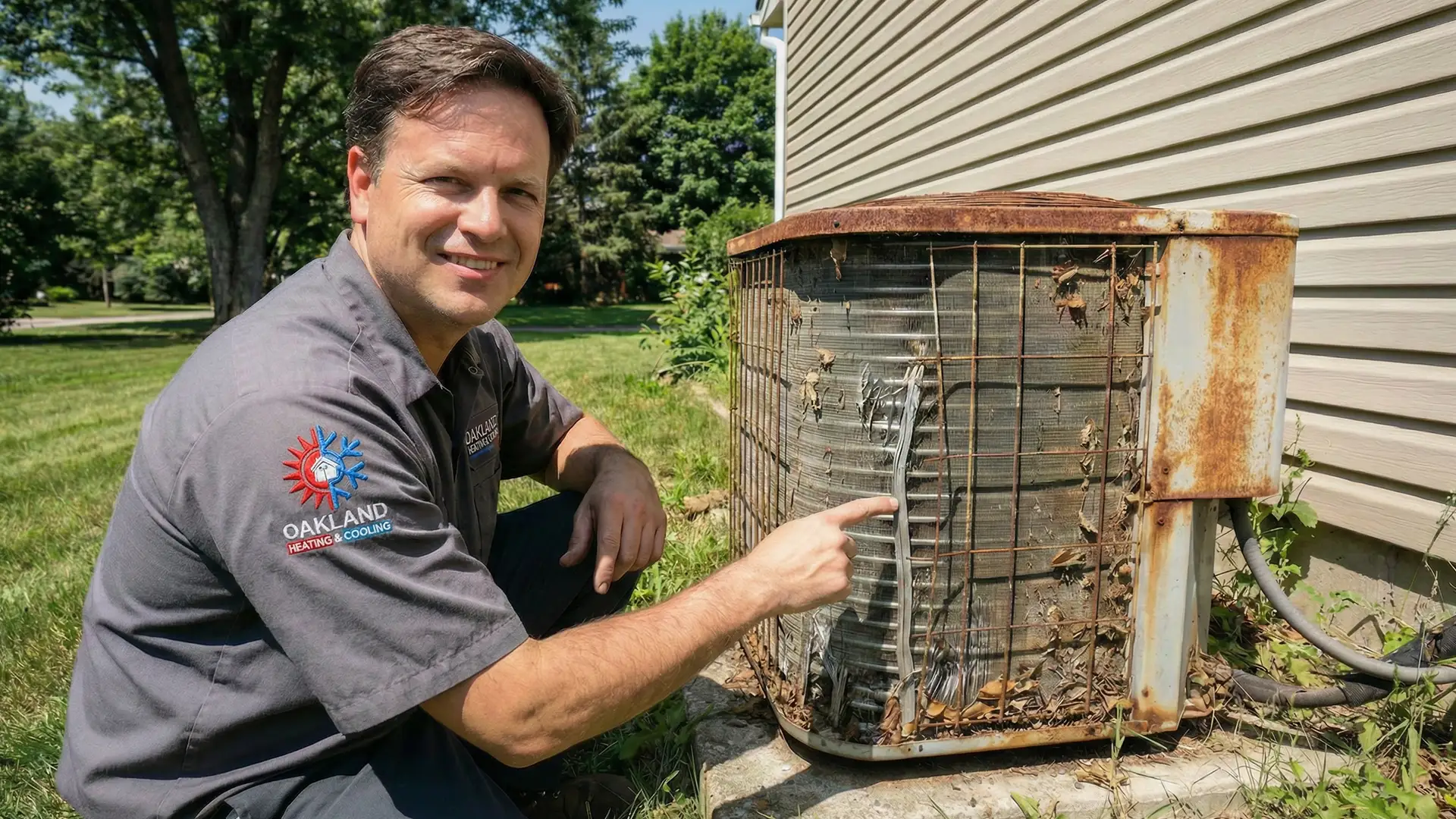
The top signs indicating your AC needs replacement include frequent breakdowns, rising energy bills, and an inability to properly cool or dehumidify your home. These problems don’t always show up all at once. A failing system usually gives you one or two warning signs first, and they tend to get worse each season. Here’s what to watch for.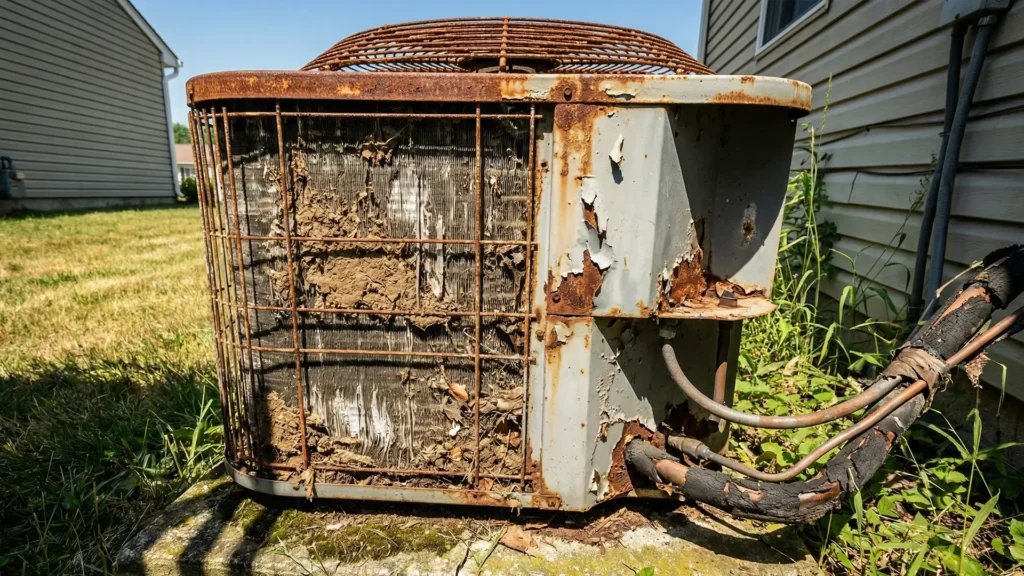
| Warning Sign | What It Likely Means | Repair or Replace? |
|---|---|---|
| System is over 15 years old | Nearing end of service life; efficiency is well below modern standards | Replace |
| Frequent repairs (2 or more per season) | System failing in multiple areas; costs adding up fast | Apply the $5,000 rule |
| Rising summer energy bills | Declining efficiency; unit running longer to reach the same temperature | Apply the $5,000 rule |
| Still uses R-22 refrigerant | Recharge costs $600-$3,000; R-22 production banned since 2020 | Replace |
| Home feels sticky and humid | AC losing dehumidification function; mold risk increases | Get an evaluation |
| Strange noises or burning smells | Internal components failing or possible electrical issue | Apply the $5,000 rule |
| System is 20 years old or older | Exceeded expected service life; parts may be obsolete | Replace |
The system is over 15 years old
If your air conditioner was installed more than 15 years ago, it is nearing the end of its mechanical life and is likely operating at a much lower efficiency than modern standards. Older units weren’t built to the efficiency benchmarks that exist today. A system from 2008 or 2009 might carry a SEER rating of 10 or 11, while current equipment sold in Michigan must meet a minimum of 15.2 SEER2. That efficiency gap shows up directly on your summer electric bill. Age also makes systems more vulnerable to serious failure. Compressors, capacitors, and evaporator coils wear down over time, and replacing one expensive part on an aging system rarely solves the underlying problem. There’s almost always another failure waiting a season or two behind it.Pro Tip: The installation date is usually printed on the data plate of the outdoor condenser unit. If you can’t locate it, an HVAC technician can determine the age quickly during a diagnostic visit.
You are facing frequent, expensive repairs
Needing more than one repair per season or facing a repair bill that exceeds $1,000 is a strong indicator that your system is failing. One repair per year can be perfectly normal, especially on an older unit. Two or three repairs in a single season is a different story. At that point, you’re patching a system that’s breaking down in multiple places at once, and every dollar spent on repairs is money that doesn’t go toward a reliable replacement. The $5,000 rule (covered in detail in the next section) is the industry’s standard tool for deciding when repair costs have crossed the line into replacement territory.Pro Tip: Keep a simple log of every repair on your AC – dates, what was fixed, and what it cost. That history gives a technician the full picture and helps you apply the $5,000 rule with real numbers instead of estimates.
Your energy bills are steadily increasing
Unexplained increases in your summer electric bills, even when rates haven’t changed, mean your AC is working harder and longer to produce the same amount of cooling. Air conditioning accounts for 12 to 27% of a home’s total energy use. When an aging system loses efficiency, it runs longer cycles to reach your thermostat setting — and that extra runtime adds up on your DTE Energy bill month after month. If your summer bills have been creeping up over the past few years without a clear explanation, your AC’s declining efficiency is likely a contributing factor.Pro Tip: Pull up your last two or three summers of utility bills and compare them side by side. A steady upward trend – without major rate increases – is one of the most reliable signals that your system is working harder than it should.
The unit still uses R-22 refrigerant (Freon)
If your air conditioner uses R-22 refrigerant, it should be replaced because this chemical was banned by the EPA in 2020 and is now prohibitively expensive to recharge. The EPA’s R-22 phase-out banned the production and importation of R-22 on January 1, 2020. If your system uses R-22, it was manufactured before 2010 — which means it’s at least 15 years old and running on a refrigerant sourced entirely from dwindling stockpiles. A refrigerant leak in an R-22 system isn’t a minor fix. Recharging a typical 6 to 12 pound system now costs between $600 and $3,000 for the refrigerant alone. That number almost always triggers the $5,000 replacement rule immediately, before you even factor in the labor. You can check your unit’s refrigerant type on the data plate of the outdoor condenser. If it lists R-22 or “Freon,” replacement is the only financially sensible path forward.Pro Tip: Don’t let anyone talk you into topping off an R-22 system without locating and fixing the leak first. Refrigerant doesn’t get used up – if your system is low, there’s a leak. Paying to recharge without fixing the source is money you’ll lose again within a season.
Your home feels humid and uncomfortable
An air conditioner that leaves your home feeling sticky and humid is failing to remove moisture from the air, which is a primary function of a healthy cooling system. This warning sign often gets dismissed because homeowners assume humidity is just part of Michigan summers. But a functioning AC should be pulling significant moisture out of the air as it cools. When you walk inside on a July afternoon and still feel that heavy, clammy feeling, the system isn’t doing its full job. Uncontrolled indoor humidity above 60% creates conditions that encourage mold growth, especially in basements. If you’re noticing musty odors alongside the discomfort, don’t ignore it.Pro Tip: A basic indoor humidity monitor (a hygrometer) costs under $20 at any hardware store. Healthy indoor humidity should stay between 40 and 50%. Consistent readings above 60% in summer point to a dehumidification problem your AC should be catching.
Your AC is making strange noises or unusual smells
Grinding, banging, or squealing sounds coming from your air conditioner are a sign that internal components are wearing out, and musty odors often point to mold growth inside an aging system. A healthy AC runs with a steady, low hum. If yours is rattling on startup, squealing when it cycles, or making a grinding noise during operation, those are mechanical red flags. Banging usually means something is loose or broken inside the unit. Squealing often points to a failing belt or motor bearing. None of those sounds fix themselves. Musty or burning smells are a separate concern. A burning odor can indicate an electrical issue. A musty smell typically means mold or mildew has built up on the evaporator coil or in the drain pan – a problem that gets worse in Michigan’s humid summers and can affect your indoor air quality. One repair might clear up a noise or odor issue. But if the smells or sounds return within a season, or if you’re dealing with both at once on an older system, it’s time to weigh repair costs against replacement using the $5,000 rule.Pro Tip: Don’t ignore a burning smell. Turn the system off and call a technician before running it again. Electrical issues left running can cause bigger problems than a failed AC.
How do you use the $5,000 rule for HVAC replacement?
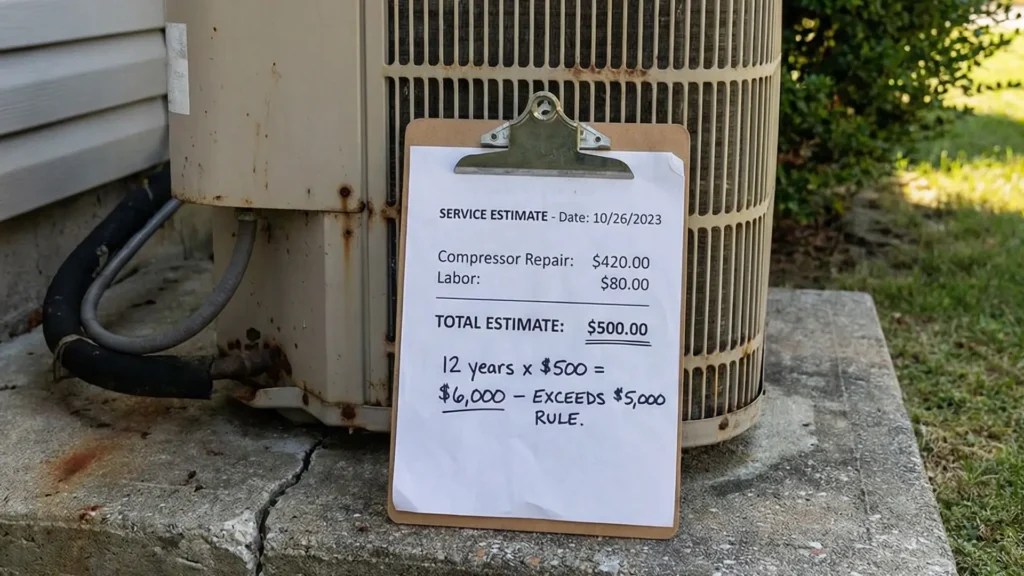
To use the $5,000 rule, multiply the age of your AC unit by the estimated cost of the repair; if the total is over $5,000, you should replace the system.
The math is simple. Say you have a 12-year-old AC and you’re looking at a $350 repair. Multiply 12 by 350, and you get $4,200 — under the $5,000 threshold, so repair is probably the right call. But if that same 12-year-old unit needs a $500 repair, the math comes out to $6,000. At that point, the numbers point toward replacement.
Here’s the other side of it. A 5-year-old unit with an $800 repair bill gives you $4,000 — well under the threshold. On a newer system, repair almost always makes sense because you still have years of reliable life ahead of you.
The rule isn’t perfect, but it’s the closest thing the industry has to a consistent decision-making tool. It accounts for both the repair cost and the remaining value of the equipment at the same time.
For a full breakdown of what a new system will run you in this market, see our guide on how much a new AC replacement costs in Southeast Michigan.
Pro Tip: Use the actual repair quote as your number, not an estimate. Get the diagnostic in writing so the math is based on real figures.
Is it worth fixing a 20-year-old air conditioner?
It is almost never worth fixing a 20-year-old air conditioner because the repair costs will be high, the parts may be obsolete, and the unit’s energy inefficiency is already costing you money every month.
At 20 years old, an AC has exceeded its expected service life. Even if you fix the immediate problem, the machine is likely to develop another failure within a season or two. Parts for older units can be difficult to source and expensive when they’re available at all.
There’s also the ongoing cost of inefficiency. A 20-year-old system running at a SEER rating of 8 or 9 costs noticeably more to operate every month compared to a modern unit. The money spent on that repair would be better put toward a new system that starts working more efficiently from Day 1.
Pro Tip: Use the actual repair quote as your number, not an estimate. Get the diagnostic in writing so the math is based on real figures.
Are there rebates available for AC replacement in Michigan?
Yes, Michigan homeowners can receive up to $300 in rebates from DTE Energy when upgrading to a qualifying high-efficiency central air conditioner.
The DTE Energy rebate program is tiered by efficiency rating. A unit rated 18 SEER2 or higher earns a $300 rebate. Units rated 16 to 17.99 SEER2 qualify for $200. Units in the 15.2 to 15.99 SEER2 range receive $100.
At Oakland Heating and Cooling, we handle the rebate paperwork for our customers so you don’t have to track down the forms yourself. If you’re a Consumers Energy customer, separate rebate programs may also apply — ask us when you call.
Pro Tip: If you’re on the fence between efficiency tiers, factor in the rebate alongside long-term energy savings. The premium for an 18 SEER2 unit often pays for itself faster than homeowners expect when utility savings are added up over two or three summers.
When should you call a professional for an AC evaluation?
You should call a licensed HVAC professional for an evaluation as soon as you notice strange noises, weak airflow, or if your system struggles to keep up with the thermostat setting.
You don’t need to wait until the system stops working entirely. Catching a problem early gives you options — sometimes a minor fix extends a system’s life by several more years. Waiting until the hottest week of August means fewer scheduling options and decisions made under pressure.
Oakland Heating and Cooling serves Oakland County homeowners in Oxford, Lake Orion, Rochester Hills, Troy, Birmingham, and the surrounding communities. Our diagnostic process is built around giving you an honest read on your system. John has been doing this for over 20 years, and the approach has always been the same: people before profits. We’ll tell you exactly what we see and give you the information to make the right call for your home.
If your system is showing any of the signs covered in this guide, contact us for a no-pressure evaluation. Same-day service is available throughout Oakland County.
Pro Tip: Scheduling an evaluation in spring – before cooling season starts – gives you the most flexibility. You’re not rushing a decision in the middle of a heat wave, and installation timelines are shorter when demand is lower.
Frequently Asked Questions
Here are answers to some of the most common questions Michigan homeowners have about replacing their air conditioning systems.
What is the most expensive part of an AC system to replace?
The compressor is the most expensive single component in an AC system, with replacement costs typically running between $1,500 and $2,500 for the part alone. On any unit over 10 years old, a failed compressor almost always justifies replacing the entire system rather than just the one part. Putting a new compressor in an aging AC is a lot like replacing the engine in a car with 200,000 miles on it – the rest of the machine is just as worn out.
Does an aging AC unit raise my energy bills?
Yes, an older AC unit will steadily increase your summer energy bills even if your usage habits haven’t changed. As mechanical components wear down, the system has to run longer cycles to reach your thermostat setting, which means more electricity is consumed for the same result. Air conditioning already accounts for 12 to 27% of a home’s total energy use – an inefficient system pushes that number higher every season it keeps running.
Will a new AC unit improve my indoor air quality?
A new AC unit can improve your indoor air quality by filtering air more effectively and controlling humidity levels better than an aging system. Older units with worn components often allow humidity to climb above comfortable levels, which encourages mold and mildew growth inside the system and throughout your home. Newer systems paired with a quality filter or whole-home air purifier give you much better control over what your family is breathing, especially during Michigan’s humid summer months.
Will a new AC unit increase my home's value?
Yes, a new high-efficiency central air conditioning system can increase your home’s resale value and make it more attractive to buyers. Buyers factor in the age of major systems when making offers, and a brand-new AC removes a potential negotiating point. In a competitive market like Oakland County, updated mechanicals are a genuine selling advantage.
How long does it take to install a new central AC unit?
A standard central AC replacement typically takes a professional crew between 4 and 8 hours to complete, so your home is cooling again the same day in most cases. More involved installs – such as pairing a new AC with a new air handler or running new refrigerant lines – may take a bit longer. Your technician will give you a clear timeline before work begins so you can plan your day accordingly.
What happens if I keep running an AC that needs to be replaced?
Running a failing AC past its useful life means paying more in repairs, more on your energy bills, and risking a complete breakdown on the hottest day of the year. Aging systems also struggle to control humidity, which can lead to mold growth and declining air quality inside your home. The longer a worn-out unit runs, the fewer options you have – a planned replacement on your schedule is almost always less stressful and less expensive than an emergency call in August.